Introduction: The King of Gaming, 3D V-Cache
AMD’s 3D V-Cache technology has been hailed as the “king of gaming performance” since its initial release. This technology, which vertically stacks L3 cache on top of the CPU die, expanding it from 384MB to up to 1,152MB, is precisely optimized for the random data access patterns prevalent in gaming.
The Ryzen 9 9950X3D achieves a 54% FPS improvement in Baldur’s Gate 3 and a 37% improvement in Starfield compared to the standard 9950X. It also offers a 15% gaming performance boost over its predecessor, the 7950X3D. This is not merely a “slightly faster” improvement but a generational leap.
The gaming community evaluates it as follows: “While 3D V-Cache may not match standard models in pure multi-threaded performance, it virtually removes all limitations in the specific domain of gaming.” Indeed, the phenomenon of the lower-cost 7800X3D outperforming the expensive, high-clock Intel Core i9-13900K in gaming clearly demonstrates the importance of cache.
Detailed Gaming Benchmark Analysis
Performance Differences Based on Cache Sensitivity
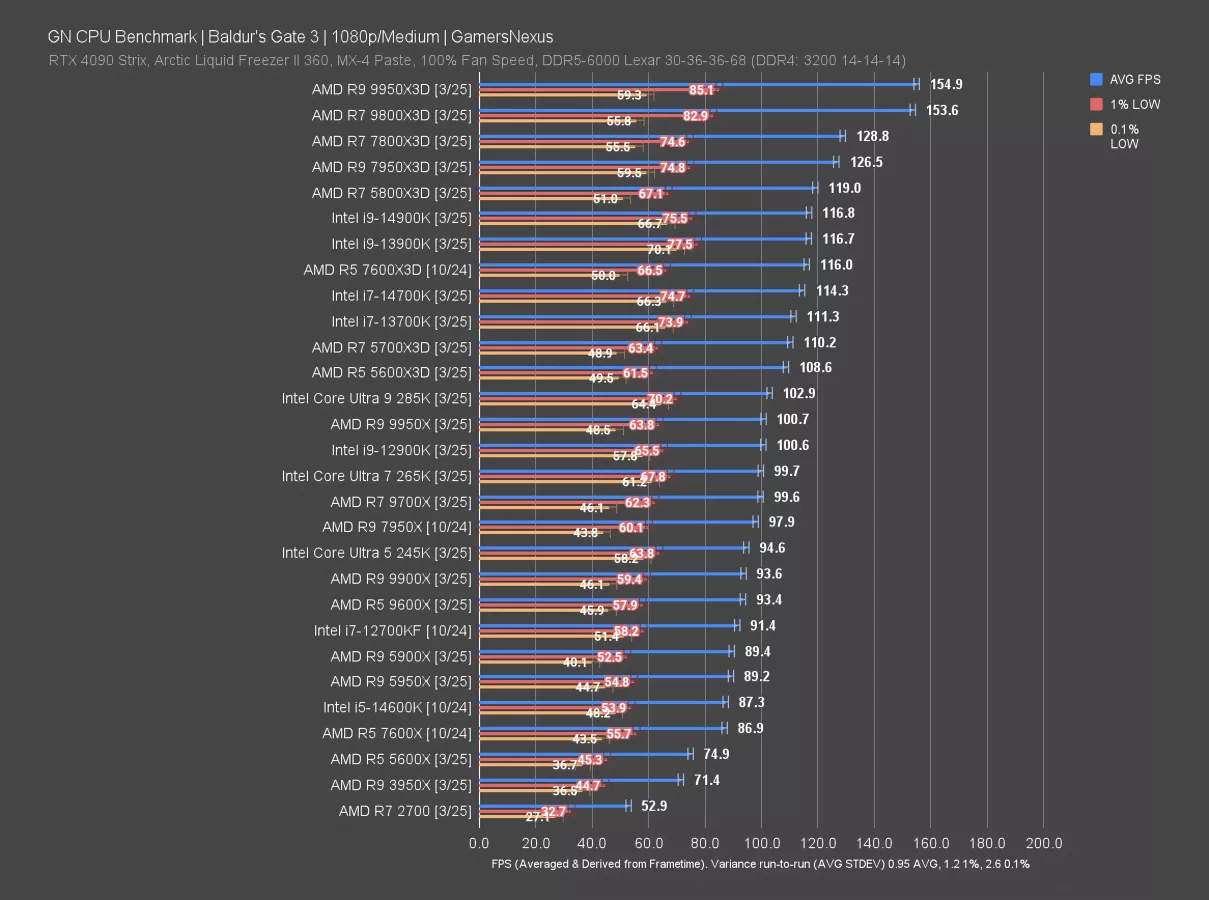
It is interesting to note that the effect of 3D V-Cache varies dramatically by game.
Games highly sensitive to cache:
- Baldur’s Gate 3: 9950X3D 155 FPS vs 9950X 101 FPS (54% improvement) - A turn-based RPG where vast map data and entity states, when loaded into L3, lead to a performance explosion.
- Starfield: 9950X3D 171 FPS vs 9950X 124 FPS (37% improvement) - High CPU load in a vast space simulation.
- Final Fantasy XIV Dawntrail: 9950X3D 373 FPS vs 9950X 323 FPS (16% improvement) - Dynamic rendering in an MMORPG.
GPU bottlenecked workloads:
- Cyberpunk 2077: 9950X3D 219 FPS vs 9950X 219 FPS (nearly identical) - GPU is the bottleneck in high-resolution ray tracing, making CPU performance differences negligible.
Dramatic Improvement in Minimum FPS
A more detailed analysis of previous generations reveals the true value of 3D V-Cache in terms of gaming “smoothness.”
Red Dead Redemption 2 (FHD Max Settings):
- Average FPS: 7950X 140.9 vs 7950X3D 141.57 (nearly the same)
- Minimum FPS: 7950X 86 vs 7950X3D 106.7 (24% improvement) ← Significantly enhances perceived game fluidity.
Cyberpunk 2077 (FHD Ultra):
- Average FPS: 7950X 209.6 vs 7950X3D 214 (minor 2% difference)
- Minimum FPS: 7950X 56.7 vs 7950X3D 73.8 (30% improvement) ← Reduces stuttering.
This pattern offers a crucial insight: 3D V-Cache is a technology that ensures “minimum performance stability” rather than “maximum performance.” If average FPS is in the 60s but minimum FPS drops to 30, the game feels “choppy.” 3D V-Cache raises these frame rate troughs, fundamentally improving the gaming experience.
Game developers also acknowledge this: “3D V-Cache is a technology that almost perfectly equalizes game performance. It largely eliminates the game FPS difference between single-threaded, dual-core CPUs and high-clock multi-core CPUs.”
Turning Point: Expansion Beyond Gaming to Servers and HPC
The Advent of EPYC Server CPUs and a Paradigm Shift
AMD’s integration of 3D V-Cache into its EPYC 9000 series (Genoa) server platform in 2023 marked a significant turning point. It wasn’t just an “advanced feature” but defined a new standard for data center performance.
The general perception was:
- Gaming CPU 3D V-Cache (Ryzen): Performance optimized exclusively for gamers.
- Server CPU 3D V-Cache (EPYC): A technology with an entirely different purpose.
However, actual data shattered this notion.
Redis In-Memory Database: More Than Double the Throughput
Specific Benchmark Figures
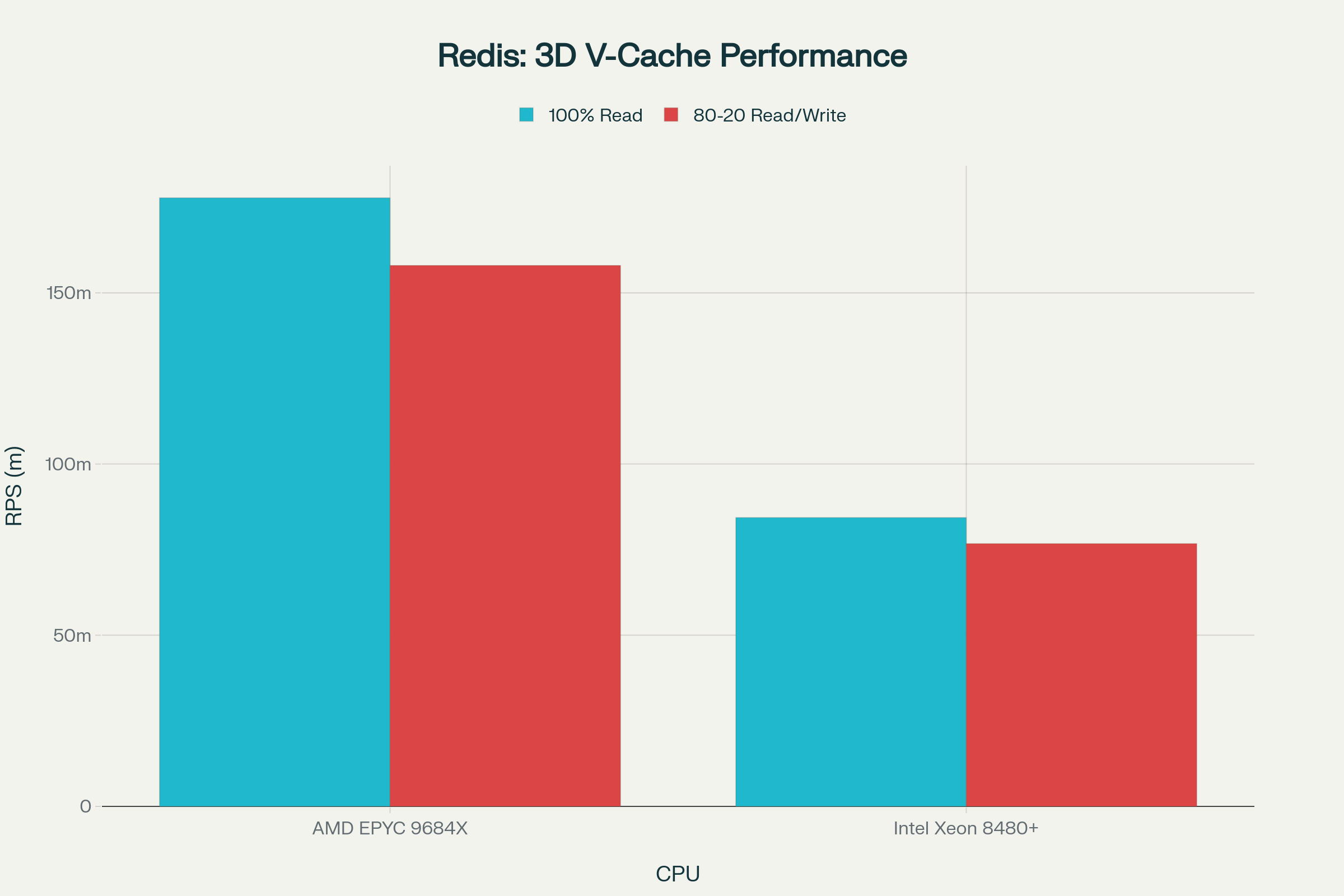
Principled Technologies’ benchmark (EPYC 9684X vs Intel Xeon 8480+) clearly demonstrates the impact of 3D V-Cache in in-memory workloads.
100% Read Workload (Pure Query Performance):
- AMD EPYC 9684X (3D V-Cache): 177.7M RPS (Requests Per Second)
- Intel Xeon 8480+: 84.4M RPS
- Performance Improvement: 110.7% (more than double)
80-20 Read/Write Mix:
- AMD EPYC 9684X: 158.0M RPS
- Intel Xeon 8480+: 76.8 RPS
- Performance Improvement: 105.8%
Considering Power Efficiency:
- Performance/Watt: 9684X 175,894 vs 8480+ 84,162
- Efficiency Improvement: 109% (double the processing for the same power)
Why Does the Same Principle Apply to Redis as to Gaming?
This result breaks the conventional wisdom that “gaming and databases are completely different.” The reason lies in the commonality of cache access patterns:
- Random Data Access: Both game entity lookups and Redis key-value lookups access data at unpredictable locations.
- Working Set Suitable for L3: Both game map data and game states, and Redis’s frequently used hot data, fit into the large L3.
- Memory Latency Determines Throughput: In both cases, a higher L3 hit rate reduces DRAM access, improving latency.
The difference between gaming and Redis is scale. A personal Ryzen gaming CPU has a maximum of 96MB L3, while a server EPYC 9684X has 1,152MB L3. Thus, the benefit is maximized from 20-54% in gaming to over 110%.
Cloudflare Production Environment: 145% Throughput Improvement Verified
Validation in Large-Scale Operational Environments
Cloudflare adopted EPYC 9684X (Genoa-X) in its 12th-generation infrastructure and published results from an in-depth analysis of its actual production workloads.

“The 9684X achieved 145% higher throughput and 63% higher power efficiency compared to the standard EPYC 9654. This improvement is purely due to the difference in L3 cache size with the same number of physical cores.”
What does this 145% improvement mean? It can be interpreted as follows:
- 8 standard Genoa nodes can be replaced by 4 9684X nodes.
- 50% reduction in data center rack space.
- Significant reduction in cooling and power supply costs.
Cloudflare actually published calculations: “Even with DDR5 bandwidth doubling compared to previous DDR4, L3 cache size still determines performance. The influence of cache in the memory hierarchy is an immutable law.”
OpenFOAM CFD Simulation: 2x Performance Leap
HPC Simulation Workloads
Computational Fluid Dynamics (CFD) is a typical HPC workload that performs large-scale mesh data and iterative numerical analysis. In this field, 3D V-Cache brings performance improvements far exceeding gaming levels.
OpenFOAM Benchmark Results:
- EPYC 9684X (Genoa-X, 1,152MB L3): 2.08x baseline performance
- EPYC 9654 (Standard Genoa, 384MB L3): 1.0x (baseline)
- Intel Xeon 8462Y+ (HBM-based): 0.53x
The practical implications are:
- 1 9684X node = performance of 2 standard Genoa nodes.
- Even 3.9 times faster than Intel’s HBM-based high-end CPUs.
Emergence of Superlinear Scaling
A more intriguing phenomenon is observed in the 8-node cluster test results. Theoretically, 8 9684X nodes should equal 16 standard Genoa nodes, but:
- Actual performance: 8 9684X nodes = approximately 13 Genoa nodes (superlinear scaling occurs).
Why does this happen? The reason lies in the working set loading threshold:
- Standard Genoa (384MB L3): Only a portion of mesh data is loaded into L3 → frequent DRAM access → induces inter-node communication.
- 9684X (1,152MB L3): Most mesh data and intermediate results reside in L3 → almost no DRAM access → reduced inter-node communication → increased scaling efficiency.
In other words, a large L3 does not merely “speed up individual nodes” but reduces the synchronization overhead of the entire cluster, leading to superlinear scaling.
EDA Simulation: Synopsys VCS Verification Acceleration
Solving Bottlenecks in Semiconductor Design Verification
In the semiconductor design industry, the role of 3D V-Cache is particularly important. Synopsys VCS (Verification Compiler System) is a tool for functionally verifying millions of lines of design, with extremely irregular memory access patterns.
Performance Improvement:
- EPYC 9384X (4th Gen, 3D V-Cache) vs EPYC 7573X (3rd Gen, Standard)
- Approximately 1.28x acceleration (same 32 cores).
Actual Impact:
- Design database queries (irregular access like meshes): Direct acceleration from L3 cache.
- Event simulation (state transition search): Performance explosion when branched paths enter L3.
- Shape exploration (SAT solver, etc.): Maximized caching efficiency for partial solutions of NP-hard problems.
Categorical Summary of 3D V-Cache
Summarizing the analysis so far, the value of 3D V-Cache is spreading from gaming to servers, HPC, and EDA.
Maximum Effect: Gaming, In-Memory DB, HPC Simulation
| Workload | Performance Improvement | Reason |
|---|---|---|
| Gaming (Baldur’s Gate 3, etc.) | 20-54% | Map/entity data loaded into L3, cache hit rate 70-90% |
| Redis 100% Read | 110% (2x) | Most hot data resides in large L3 |
| CFD Simulation | 2x or more | Mesh data loaded into L3 → superlinear scaling |
| Cloudflare Production | 25-145% | Linear increase in throughput due to reduced cache miss rate |
Limited Effect: Network Bottleneck, GPU Bottleneck, Sequential Streaming
| Workload | Performance Improvement | Reason |
|---|---|---|
| GPU Bottlenecked Games (Cyberpunk 2077) | 0% | GPU is the bottleneck, CPU improvements ignored |
| Distributed Systems (Microservices) | 0-10% | Network latency overwhelms CPU cache benefits |
| Sequential Streaming (Render, Compile) | 5-10% | AVX/vector performance and clock speed are more important |
| Memory Streaming (Large Matrices) | 0-5% | Memory bandwidth is the bottleneck, low cache hit rate |
Technical Insight: Why Do Gaming and Server Workloads Benefit from the Same Cache?
Common Characteristics of Cache Affinity
The reason 3D V-Cache is effective in both gaming and servers lies in cache affinity patterns:
-
High Reuse Rate (Reuse Distance):
- Gaming: Repeatedly queries entity states (multiple times per frame).
- Redis: Queries hot keys millions of times per second.
- Both access the same data multiple times within a short period.
-
Large Working Set:
- Gaming: Requires hundreds of MBs of scene data at once.
- Redis: Requires GBs of datasets.
- Standard CPU L3 (64-96MB) is insufficient; large L3 (384-1152MB) is essential.
-
Unpredictable Access (Random Access):
- Gaming: Access patterns change based on player actions.
- Redis: Key access order changes based on user queries.
- Prefetching is ineffective → L3 cache size is directly critical.
This clearly demonstrates the limitations of L1-L2 caches from a CPU architecture perspective. While L1 (32KB) and L2 (512KB) are good for sequential access optimization, for random access of large, unstructured datasets, L3 size is dominant.
Practical Application: ROI Analysis
When to Adopt 3D V-Cache?
High ROI (Immediate adoption recommended):
-
Gaming PC/Workstation:
- Targeting high refresh rate gaming → 9950X3D, 9800X3D recommended.
- 1% low frame stability is paramount → 3D V-Cache is essential.
-
In-Memory Database Services:
- Redis, Memcached-centric backend → Adopt EPYC 9684X (Genoa-X).
- 2x throughput = 50% reduction in server count = 30% reduction in 5-year TCO.
-
HPC Clusters:
- CFD, FEA, AI training, etc. simulations → Reduce node count by 30% with Genoa-X.
- Reduce power and cooling costs while halving processing time.
Medium ROI (Evaluate carefully):
-
Mixed Workload Databases (OLTP + Analytics):
- Benefits in OLTP, limited in analytics.
- Actual benchmarks are essential.
-
Microservices Architecture:
- CPU cache benefits may be overshadowed by network latency.
- Decide after measuring latency.
Low ROI (Not recommended for adoption):
-
GPU-centric Workloads (Deep Learning Inference):
- GPU bottleneck, CPU improvements ignored.
- Standard models are sufficient.
-
Streaming Data Processing (Log collection, Event processing):
- Primarily sequential access, low cache hit rate.
- High clock speed, more cores are more effective.
Conclusion: Gaming Innovation Transforms the Data Center
AMD’s 3D V-Cache started as a “gaming CPU technology,” but actual benchmarks and production environment data have proven that the fundamental characteristic of cache affinity is applicable not only to gaming but also to a wide range of fields such as servers, HPC, and EDA.
Key Insights:
- Gaming: 20-54% performance improvement, stabilized minimum FPS.
- Redis: Over 110% throughput improvement, 2x power efficiency.
- Cloudflare: 145% throughput, 50% node reduction.
- CFD: 2x performance, superlinear scaling.
3D V-Cache can no longer be called a “gamer-exclusive technology.” It signifies a paradigm shift for all workloads where memory access latency determines performance, redefining the very criteria for CPU architecture selection.
References
- AMD - 3D V-Cache Technology Overview
- Gamers Nexus - AMD Ryzen 9 9950X3D CPU Review & Benchmarks
- Principled Technologies - EPYC 9004 Processors & Redis Competitive Analysis
- Cloudflare’s 12th Generation servers — 145% more performant and 63% more efficient
- AMD - OpenFOAM & 3D V-Cache Technology
- AMD Performance brief - SYNOPSYS® VCS® PERFORMANCE UPLIFTS