Recent Surge: Q3 Earnings Surprise
Unity Software’s stock surged 18% after its third-quarter earnings, announced on November 5, 2025, significantly beat Wall Street expectations. The stock soared from $35.87 to $42.50 in pre-market trading, approaching its 52-week high of $46.94.
Key Performance Indicators
- Revenue: $471 million (up 5% YoY, beating estimates of $452.76 million by 4.0%)
- Adjusted EPS: $0.20 (Turnaround to profit)
- Adjusted EBITDA: $109 million, with a 23% margin (11.6% above the expected $98.15 million)
- Free Cash Flow: $151 million (a $36 million increase YoY, representing 31% growth)
This performance marks a turning point, showing a full recovery from the sluggish performance in Q1. The shift from negative to positive cash flow has fundamentally improved the company’s risk profile.
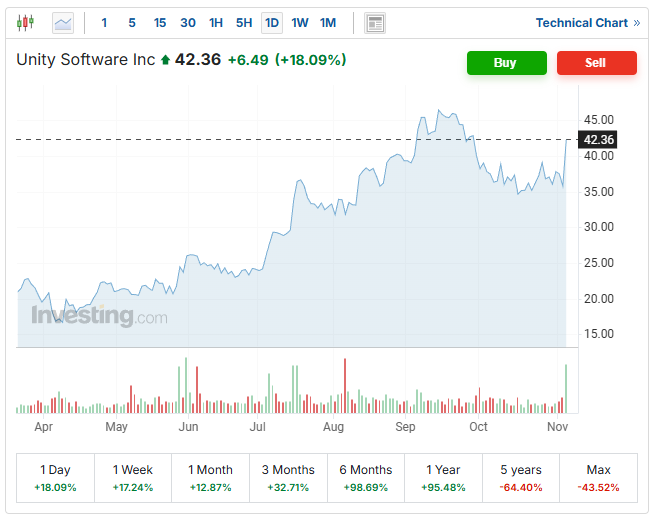
Unity Stock Chart. https://www.investing.com/equities/unity-software-inc
Q1 2025: Recovery from sluggish performance
Q1 2025 Performance Analysis
| Item | Q1 2025 | Description |
|---|---|---|
| YoY Revenue | -6% | Revenue decline in progress, impact of portfolio reset |
| Grow Segment | -4% | Weakness in ad performance marketing market, Vector AI in early stages |
| Create Segment | -8% | Sluggish demand for game development tools, decline in professional services revenue |
| Net Loss | -$78M | 73% improvement from -$291M in the same period last year |
| Adjusted EPS | $0.24 | Turnaround to profit from -$0.19 in Q1 2024 |
The Meaning of the sluggish Q1 Results
Q1 2025 represents the peak of the structural challenges and corporate turmoil Unity faced:
Background of Revenue Decline
- Divestment of non-strategic businesses due to the portfolio reset ending in 2024
- Partial sale of high-margin businesses in the Grow segment (adjustment of relationship with IronSource)
- Slow growth in the game market and sluggish ad spending
- Vector AI platform was still in its early stages with minimal revenue contribution
The Meaning of Loss Improvement
- The 73% reduction in GAAP net loss from $291M to $78M signifies the success of restructuring
- Improved fixed cost structure through workforce reduction (2,600 employees) and operating cost savings
- Increase in adjusted EBITDA from $79M to $84M, with margin improvement (17%→19%)
Investor Reaction and Market Evaluation
- After the Q1 earnings announcement, the stock price actually fell by 0.88% due to concerns about the revenue decline
- However, this was due to weak guidance for Q2 and below, and the normalization of the company’s fixed cost structure was well-received
- The weak Q2 guidance ($415-425M) was because Vector AI had not yet contributed to growth
The Recovery Process from Q1 to Q3
- Q1: Revenue declines, but losses are reduced (improved cost structure)
- Q2: Guidance was weak, but in reality, the adoption of Vector AI began to spread
- Q3: Full-scale reflection of Vector AI platform’s performance, revenue rebound, and profit visibility
Analysis of Growth Drivers
1. Vector AI: A Game Changer
Unity’s primary growth engine is the Vector AI advertising platform. Launched in early 2025, Vector is a next-generation, machine learning-based ad engine developed to compete with AppLovin’s AXON AI.
Core Technology of Vector AI
- Drives a self-learning AI model by integrating data from across the Unity ecosystem.
- Dynamically adapts to player behavior and game changes in real-time.
- Improves ad targeting precision and optimizes Return on Ad Spend (ROAS).
- Delivers significantly enhanced performance compared to the previous Audience Pinpointer.
Contribution to Earnings
- Grow Solutions segment revenue reached $318 million (up 6% YoY and 11% sequentially).
- The Unity Ad Network grew 15% sequentially in Q2 and continued its strong growth in Q3.
- Vector is now a high-margin business accounting for about 49% of the Grow segment’s revenue.
- Needham forecasts the Grow segment to grow by 20% YoY in 2026.
Vector’s success is establishing it as a core competency for Unity, not just an ad platform. Some game companies have reported significant ROAS improvements after adopting Vector, enabling them to increase ad spending on both iOS and Android.
2. Create Solutions: Growth of the Subscription Model
The Create Solutions segment, the game development tools business, reported revenue of $152 million (up 3% YoY). Excluding non-strategic revenue, the actual growth rate is 13%.
Key Achievements
- Subscription revenue grew by 16% (excluding non-strategic revenue).
- Unity 6 downloads surpassed 6.6 million (a 50% increase from the previous quarter).
- Particularly strong growth in the Chinese market.
- Improved Average Revenue Per User (ARPU) due to price increases.
Strategic Partnerships
- Multi-year agreements with Tencent and Scopely.
- Collaboration to optimize for the Nintendo Switch 2 platform.
- Expansion into the automotive industry with BMW and Mercedes-Benz.
- Development of healthcare visualization tools.
Unity 6 is regarded as the most stable and high-performance version to date. Unity 6.2 introduced a developer data framework and a privacy dashboard, a strategic move to address strengthening global data regulations.
3. Integrated AI Technology
Unity is integrating AI across all aspects of game development.
Unity AI Suite
- Unity Muse: Generates 2D sprites and 3D textures from text prompts, improving development speed by 30%.
- Unity Sentis: Embeds neural networks into games, enabling real-time AI-driven experiences.
- Muse Chat: An AI assistant based on Azure OpenAI that provides real-time answers to developer questions.
- Unity ML-Agents: A tool for training NPCs using reinforcement learning.
AI Adoption Status
- 96% of game development studios are using AI tools.
- 63% use generative AI for asset creation.
- 79% have a positive view of AI tools.
Unity CEO Matt Bromberg has stated that the company is more focused on enhancing the game development experience than on generative AI. This is interpreted as a strategy focused on long-term value creation rather than short-term trends.
Insider Trading Analysis: Was the Selling Justified?
Recent Insider Trading Activity
Key Trades in October-November 2025
- Tomer Bar-Zeev (Director): Sold 250,000 shares on November 3 for approximately $9.49 million (at an average price of $37.94-$38.55).
- Chief Accounting Officer: Sold 802 shares on October 16 for approximately $29,000 (at $36.22).
- Over the last 90 days, insiders sold a total of 2,386,951 shares for $101.34 million.
Nature of the Trades
- Most were automatic trades under Rule 10b5-1 plans established between September 2024 and March 2025.
- The purpose was to cover taxes related to the vesting of Restricted Stock Units (RSUs).
- Classified as non-discretionary trades.
Evaluation of Selling-Time
Stock Price at the Time of Sale
- Bar-Zeev’s selling price: $37.94-$38.55.
- Current stock price (as of November 6): Approximately $42.36.
- Stock price after Q3 earnings announcement: $42.36 (+18%).
Conclusion: Premature Selling
Insiders sold at the $36-$38 level just before the Q3 earnings announcement, but with the stock surpassing $42 after the announcement, they missed out on an additional 10-15% gain.
Evaluation Factors
- Tax-Motivated Trades: Most trades were for tax obligations related to RSU vesting and were not related to the company’s outlook.
- Pre-Planned Trades: The Rule 10b5-1 plans were established 6-12 months in advance, making it impossible to predict the timing of the earnings announcement.
- Still-High Holdings: After the sale, Bar-Zeev still indirectly holds 1.3 million shares through Agathy Holdings and directly holds 760,000 shares.
Comparison with Industry Practices
- RSU-based compensation is common in tech companies, and automatic sales to cover taxes are standard practice.
- Unity’s historical pattern from 2020-2024 is dominated by similar tax-motivated trades.
Overall Assessment: The insider selling should be seen as standard tax and liquidity management rather than a negative signal about the company’s prospects. In fact, the timing of the sales was early, suggesting they may not have fully anticipated the company’s strong performance. Therefore, it is difficult to say they “sold well.”
AI Strategy and Future Outlook
Transition to an AI-Based Business Model
Unity’s AI strategy is built on three pillars:
1. Ad Optimization (Vector AI)
- Real-time bid optimization based on machine learning.
- Player behavior prediction and targeting of high-value users.
- Dynamic ad performance improvement.
2. Game Development Tools (Unity Muse & Sentis)
- Reduced development time and lower entry barriers.
- Support for small studios with AI-based asset generation.
- Enables the implementation of real-time AI experiences.
3. Industry Expansion
- Automotive (BMW, Mercedes-Benz).
- Architecture and engineering.
- AR/VR and the metaverse.
- Healthcare visualization.
Market Opportunity and Competitive Landscape
Game AI Market Outlook
- Expected to reach $6.32 billion by 2028 (29.6% CAGR).
- Increasing demand for VR/AR games.
- Expansion of cloud gaming.
Competitive Situation
- AppLovin: A leader with AXON AI, with a market cap of $165.9 billion versus Unity’s $16.9 billion.
- The gap widened after Unity rejected AppLovin’s $20 billion acquisition offer in 2022.
- Unity is attempting to regain competitiveness with the launch of Vector AI.
Unity’s Competitive Advantages
- 70% market share among the top 1,000 mobile games.
- 30% market share among the top 1,000 PC games (Steam).
- An ecosystem of over 5.5 million registered developers.
Financial Outlook and Valuation
Q4 2025 Guidance
- Revenue: $480 million to $490 million (2-4% sequential growth).
- Grow segment: Mid-single-digit sequential growth.
- Create segment: High-single-digit YoY growth.
Long-Term Outlook
- Needham expects 20% YoY growth for the Grow segment in 2026.
- Continued improvement in Vector’s machine learning is expected.
- Potential for double-digit growth.
Valuation Analysis
- Current stock price: Approximately $42.
- Fair value estimate: $33-$38 (DCF model).
- P/S ratio: 9x (industry average of 5.29x, peer average of 10.32x).
- Analyst ratings: Mostly neutral or buy, with price targets of $42-$50.
Goldman Sachs raised its price target from $38 to $42 while maintaining a neutral rating, and Needham raised its target from $40 to $50. The current valuation is slightly in the overvalued territory, but it could be justified if Vector AI’s success and a return to growth in 2026 materialize.
Rapid Change in Unity’s Revenue Composition
Quarterly Detailed Analysis Table
| Period | Create Solutions ($M) | Create % | Grow Solutions ($M) | Grow % | Total Revenue ($M) |
|---|---|---|---|---|---|
| Q1 2024 | 164 | 35.6% | 297 | 64.4% | 461 |
| Q2 2024 | 149 | 33.0% | 303 | 67.0% | 452 |
| Q3 2024 | 147 | 32.9% | 299 | 66.9% | 447 |
| Q4 2024 | 152 | 33.3% | 305 | 66.7% | 457 |
| Q1 2025 | 150 | 34.5% | 285 | 65.5% | 435 |
| Q2 2025 | 151 | 33.0% | 306 | 67.0% | 457 |
| Q3 2025 | 152 | 32.3% | 318 | 67.7% | 471 |
Annual Long-Term Trend Analysis
| Fiscal Year | Create Solutions ($M) | Create % | Grow Solutions ($M) | Grow % |
|---|---|---|---|---|
| FY 2022 | 716 | 51.5% | 675 | 48.5% |
| FY 2023 | 859 | 39.3% | 1,328 | 60.7% |
| FY 2024 | 614 | 33.9% | 1,199 | 66.1% |
Key Insights
1. Structural Business Model Transformation
Unity’s business has rapidly transformed from a nearly balanced 51.5% / 48.5% structure in 2022 to a 32.3% / 67.7% structure in Q3 2025. This means:
- Create Solutions (Game Development Tools): $71.6B in 2022 → $61.4B in 2024 (-29% decrease), stabilizing at $15.2B on a quarterly basis in Q3 2025
- Grow Solutions (Advertising & Monetization): $67.5B in 2022 → $119.9B in 2024 (+78% increase), accelerating to $31.8B quarterly in Q3 2025
2. Impact of Portfolio Reset
- The significant decrease in Create Solutions’ absolute revenue in FY 2024 was due to the divestment of non-strategic businesses (e.g., termination of the Weta FX contract).
- Excluding non-strategic revenue, Create Solutions’ subscription revenue is actually growing by 13-16%.
- This signifies a strategic choice to retain only high-quality customers.
3. Re-acceleration of the Grow Segment with the Introduction of Vector AI
- Transition from weakness in the Grow segment in Q1 2025 (-4% YoY) to acceleration in Q3 2025 (+6% YoY).
- In Q3, Grow Solutions revenue grew by +3.9% sequentially to $31.8B (the highest growth rate during the quarter).
- Estimated contribution of Vector AI: Accounts for about 49% of Grow segment revenue and is growing 15% faster than the normal ad network.
4. Acceleration of Business Diversification
Changes within Create Solutions
- Pure development tools (subscription): Stable growth (+13-16% YoY)
- Non-gaming industries (automotive, architecture, healthcare): Undergoing strategic expansion (+55% growth)
Changes within Grow Solutions
- Unity Ad Network (including Vector AI): Reorganized into a high-margin business
- Other advertising services: Strategically downsized
Rapid Change in Unity’s Revenue Composition
Quarterly Detailed Analysis Table
| Period | Create Solutions ($M) | Create % | Grow Solutions ($M) | Grow % | Total Revenue ($M) |
|---|---|---|---|---|---|
| Q1 2024 | 164 | 35.6% | 297 | 64.4% | 461 |
| Q2 2024 | 149 | 33.0% | 303 | 67.0% | 452 |
| Q3 2024 | 147 | 32.9% | 299 | 66.9% | 447 |
| Q4 2024 | 152 | 33.3% | 305 | 66.7% | 457 |
| Q1 2025 | 150 | 34.5% | 285 | 65.5% | 435 |
| Q2 2025 | 151 | 33.0% | 306 | 67.0% | 457 |
| Q3 2025 | 152 | 32.3% | 318 | 67.7% | 471 |
Annual Long-Term Trend Analysis
| Fiscal Year | Create Solutions ($M) | Create % | Grow Solutions ($M) | Grow % |
|---|---|---|---|---|
| FY 2022 | 716 | 51.5% | 675 | 48.5% |
| FY 2023 | 859 | 39.3% | 1,328 | 60.7% |
| FY 2024 | 614 | 33.9% | 1,199 | 66.1% |
Key Insights
1. Structural Business Model Transformation
Unity’s business has rapidly transformed from a nearly balanced 51.5% / 48.5% structure in 2022 to a 32.3% / 67.7% structure in Q3 2025. This means:
- Create Solutions (Game Development Tools): $71.6B in 2022 → $61.4B in 2024 (-29% decrease), stabilizing at $15.2B on a quarterly basis in Q3 2025
- Grow Solutions (Advertising & Monetization): $67.5B in 2022 → $119.9B in 2024 (+78% increase), accelerating to $31.8B quarterly in Q3 2025
2. Impact of Portfolio Reset
- The significant decrease in Create Solutions’ absolute revenue in FY 2024 was due to the divestment of non-strategic businesses (e.g., termination of the Weta FX contract).
- Excluding non-strategic revenue, Create Solutions’ subscription revenue is actually growing by 13-16%.
- This signifies a strategic choice to retain only high-quality customers.
3. Re-acceleration of the Grow Segment with the Introduction of Vector AI
- Transition from weakness in the Grow segment in Q1 2025 (-4% YoY) to acceleration in Q3 2025 (+6% YoY).
- In Q3, Grow Solutions revenue grew by +3.9% sequentially to $31.8B (the highest growth rate during the quarter).
- Estimated contribution of Vector AI: Accounts for about 49% of Grow segment revenue and is growing 15% faster than the normal ad network.
4. Acceleration of Business Diversification
Changes within Create Solutions
- Pure development tools (subscription): Stable growth (+13-16% YoY)
- Non-gaming industries (automotive, architecture, healthcare): Undergoing strategic expansion (+55% growth)
Changes within Grow Solutions
- Unity Ad Network (including Vector AI): Reorganized into a high-margin business
- Other advertising services: Strategically downsized
Conclusion: Unity’s Inflection Point
Unity Software’s recent stock surge is seen as a sustainable rise based on fundamental improvements. The Q3 results are not just a one-time surprise but an inflection point where two years of restructuring and strategic shifts are beginning to bear fruit.
Key Achievements
- Vector AI exceeded expectations, leading to the recovery of the Grow segment.
- Double-digit growth in the Create segment’s subscription revenue.
- A shift to positive cash flow and improved profitability.
- Strengthening the ecosystem with AI-based development tools.
Insider Trading Assessment
- Mostly mandatory, tax-related trades, not a negative signal.
- In fact, the selling was timed early, missing out on further gains.
- It is difficult to say they “sold well.”
AI Strategy
- Vector AI: A game-changer for the high-margin advertising business.
- Unity Muse/Sentis: Innovating development productivity.
- Expansion beyond gaming: Automotive, AR/VR, healthcare.
Risk Factors
- Continued competition with AppLovin.
- Uncertainty in the soft landing of the gaming market.
- High valuation (9x P/S).
- Increasing cloud costs.
Unity is overcoming past turmoil (the Runtime Fee controversy, CEO change, and mass layoffs) and is being reborn as an AI-driven growth platform. If the sustained performance of Vector AI and the expansion of Unity 6 continue, a return to double-digit growth in 2026 is expected. While a cautious approach is needed at the current stock price, Unity may offer an attractive investment opportunity for long-term investors as a game infrastructure platform in the AI era.
References
- Yahoo Finance, “Unity Software Rises on Q3 Earnings Beat” (2025-11-05)
- PocketGamer.biz, “Unity pins hopes on Vector AI ads platform to spark revenue growth” (2025-08-05)
- Investing.com, “Unity software director Bar-Zeev sells $9.49 million in stock” (2025-11-04)
- Microsoft Customer Stories, “Unity builds a game developer AI assistant with Azure OpenAI Service” (2024-05-20)
- Investing.com, “Unity Software price target raised to $50 from $40 at Needham” (2025-11-06)
Disclaimer: This article is for informational purposes only and does not constitute investment advice. All investment decisions are the responsibility of the investor, and the author is not liable for any direct or indirect losses resulting from them.