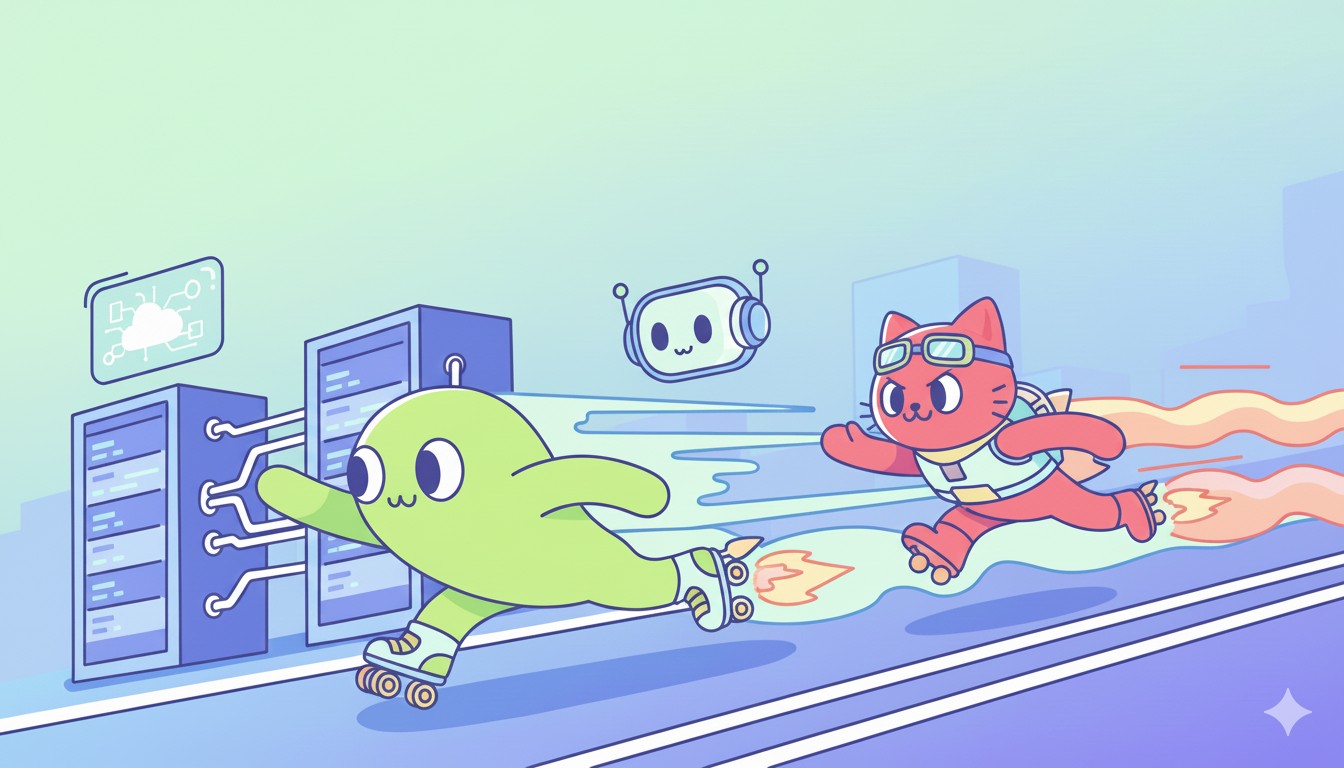
Recently, the market landscape of the artificial intelligence (AI) industry can be described as a history of one company’s monopoly and the challenges against it. While Nvidia established itself as the exclusive “high-speed data highway” of the AI era, UALink (Ultra Accelerator Link) technology, created through the collaboration of major IT companies including AMD, is gradually gaining prominence. In the second half of 2025, a large-scale investment from OpenAI is transforming this technology from a simple open standard into the seed of an ‘industrial transformation.’ Today, we will delve deep into what UALink technology is, why it has been difficult to break Nvidia’s monopoly until now, and why OpenAI’s move is a signal that will shake the market.
1. What is UALink?
UALink is an open interconnect standard that connects thousands to tens of thousands of AI accelerators, servers, and memory in massive AI data centers with ultra-high speed and low latency. To put it simply, if Nvidia’s NVLink is a ‘highway only for Nvidia cars,’ UALink is a ’national standard highway built for all cars to drive on.’
Key Features
- Open Standard: Global companies such as AMD, Intel, Google, Microsoft, and Meta have formed a consortium called the ‘UALink Promoter Group’ to jointly develop the technology.
- Scalability: Chips and servers from various manufacturers can be connected, diversifying supply chain risks and costs.
- Interoperability: It overcomes the limitations of Nvidia’s closed NVLink architecture, enabling a true multi-vendor environment.
2. Why UALink Hasn’t Succeeded So Far
Nvidia’s AI GPUs and NVLink were the market’s default, the de facto standard. While UALink remained just an idea, what made market entry so difficult?
(1) The Power of the Nvidia Ecosystem
Nvidia has bound developers and researchers worldwide with its CUDA software ecosystem. Decades of accumulated code assets, tools, and the speed and reliability of NVLink—it was already a ‘stable platform ready to use.’ The entry barrier for new technology was too high.
(2) Lack of Real-World Implementation and References
Although there were UALink specifications and whitepapers, there were no large-scale commercial products (especially, mass adoption in the cloud). There was a lack of cases and trust that “it has been used in practice and works without issues.” Nvidia GPUs were already proven in data centers, cloud vendors, and large AI research labs, but UALink remained in the ’experimental’ realm.
(3) Slow Consortium Decision-Making
The strength of an open standard is that ’everyone builds it together,’ but this is also a weakness as it ‘requires everyone’s consensus.’ Different interests and technical goals slowed down the commercialization speed compared to Nvidia’s standalone products.
(4) Performance and Optimization Uncertainty
While Nvidia NVLink provided an optimized hardware and software package, UALink initially faced controversies regarding reliability in performance, bandwidth, and latency. In AI training, the connection speed between chips determines the overall efficiency, so there were significant concerns like, “Will this really work at a large scale?”
(5) Market Inertia and Supply Chain Reality
In the 2023-2024 AI market, there was an extreme concentration on Nvidia GPUs. The ChatGPT craze and the explosion in demand for training large-scale language models forced companies to flock to ‘proven’ Nvidia solutions. There was no room to try a new standard.
3. The Game Changer: OpenAI
In the second half of 2025, news began to spread that OpenAI officially joined UALink and promised a large-scale investment. OpenAI is the operator of the world’s largest AI workloads, such as GPT-4 and 5, and is the customer with the most demanding infrastructure needs.
(1) The Emergence of the ‘Ultimate Validator’ to Gain Market Trust
If a company operating actual models at such a massive scale as OpenAI adopts a UALink-based environment, it serves as a powerful endorsement for all market players that “this is a technology that works in practice.” Once OpenAI’s practical adoption is confirmed, the suspicion that it is “still an unproven technology” will quickly disappear.
(2) A Decisive Moment for Supply Chain Diversification and Cost Reduction
The supply shortages and price hikes of Nvidia’s H100/B100 were already a chronic bottleneck in the AI industry. If OpenAI adopts UALink and AMD GPUs in large quantities, the supply chain will be diversified, and costs will be significantly reduced. This will be a critical selection criterion for both AI developers and cloud service providers.
(3) Breaking Down the Software Entry Barrier
OpenAI is directly optimizing software for UALink by developing its own frameworks like Triton, which can surpass CUDA. If OpenAI’s own framework successfully trains and operates large models in a UALink environment, the perception of the global developer community will also change.
(4) Rapid Expansion of Cloud Platforms
Major cloud companies like Microsoft, Google, and Amazon have already joined the UALink consortium. If OpenAI actively utilizes it, major cloud platforms like Azure, GCP, and AWS will have no choice but to expand the proportion of UALink-based infrastructure. The ecosystem will expand in a chain reaction.
(5) Perfect Collaboration of Hardware and Software
AMD is mass-producing new products in the MI300/MI350 series, showcasing hardware that fully implements UALink 3.0. When combined with OpenAI’s practical usage and optimization know-how, a “technology with only a standard” transforms into a “technology capable of building a large-scale commercial infrastructure.”
4. What Will Change in the Future?
Expansion of Choices
The market structure where “Nvidia is the only answer” for building AI infrastructure will be broken. A viable, cost-effective, and supply-chain-secure alternative for running large-scale models will emerge for the first time.
Technological Innovation and Price Competition
As cracks appear in Nvidia’s monopoly, prices will adjust, and the pace of innovation will accelerate. The increased practical adoption of the AMD+UALink combination will also push Nvidia to innovate faster and improve its supply chain.
Overall Health of the Industry
When various vendors share a standard, the efficiency and stability of the entire industry increase. As an open standard, UALink will foster a healthy ecosystem where cloud, hardware, and software can ‘collaborate and compete’ simultaneously.
For Both Developers and Enterprises
Initially, the expansion will be centered around large customers (like OpenAI and Microsoft), but later, more small and medium-sized AI startups, research institutions, and governments are likely to choose UALink-based AMD GPUs for their lower cost, diversity, and compatibility.
Conclusion
The strategic collaboration between UALink and OpenAI signifies more than just the emergence of a new technical standard or a single company’s groundbreaking investment; it represents a paradigm shift in the entire AI infrastructure market. The ‘highway’ of AI infrastructure is now transitioning from a closed structure monopolized by a single company to an open, scalable network in which various companies participate.
If UALink was once a ‘possibility,’ the full-fledged participation of OpenAI and the global cloud giants, coupled with the parallel maturation of hardware and software, is now ushering in an era of a ‘realistic alternative.’ Within the next one to two years, UALink will become an indispensable keyword when discussing large-scale AI model infrastructure, opening new doors of opportunity for developers, enterprises, and investors alike.
“The era when Nvidia was the only answer is coming to an end. The name of the next highway is UALink.”